

Pallet Welding Machine and Its Role in Plastic Pallet (Pallet Plastik) Manufacturing
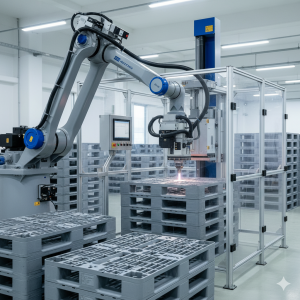
In the modern plastic industry, the pallet welding machine has become one of the most vital tools in the production of plastic pallets. This machine is designed to fuse multiple plastic components into a single, durable, and structurally stable unit. Unlike traditional assembly methods that rely on screws or adhesives, pallet welding machines use heat and pressure to bond plastic materials, creating a seamless and strong connection.
The use of welding technology in plastic pallet manufacturing not only enhances the strength and durability of the final product but also improves production efficiency and reduces the risk of material failure during use.
Working Principle of a Pallet Welding Machine
A pallet welding machine typically operates using heat-based fusion technology, such as hot plate welding, vibration welding, or ultrasonic welding.
- Hot Plate Welding: This method involves heating both plastic surfaces using a heated plate until they reach their melting point. The melted surfaces are then pressed together to form a solid bond once cooled.
- Vibration Welding: The process uses rapid mechanical vibrations under pressure to generate heat at the interface of the plastic parts, fusing them without any external heat source.
- Ultrasonic Welding: High-frequency vibrations are applied to the contact area, producing localized heat that melts and joins the plastics precisely and efficiently.
Each technique is selected based on the type of plastic material (commonly PP or HDPE), the pallet design, and the desired production speed.
Role of Pallet Welding Machines in Plastic Pallet Production
The pallet welding machine plays a central role in the assembly stage of pallet manufacturing. After injection or compression molding, different pallet components — such as the deck, legs, and runners — are welded together to form a complete structure. This process ensures:
- Uniform Strength Distribution: The welded joints provide consistent load-bearing capacity across the pallet.
- Improved Dimensional Accuracy: Welding ensures precise alignment of components, maintaining the pallet’s structural design.
- Enhanced Durability: The welds are resistant to cracking, moisture, and chemical exposure, ideal for industrial environments.
The seamless joint created by the machine also makes the pallet easier to clean, a key requirement for food, pharmaceutical, and cleanroom industries.
Advantages of Using a Pallet Welding Machine
Integrating a pallet welding machine into the production line brings multiple advantages:
- High Production Efficiency: Automated welding reduces manual labor and increases production speed.
- Consistent Product Quality: Every weld is uniform, ensuring reliable performance in every pallet produced.
- Eco-Friendly Process: The process generates minimal waste since it requires no adhesives or fasteners.
- Strong and Aesthetic Results: Welded pallets have smooth, solid surfaces with no visible seams or weak points.
Conclusion
The pallet welding machine stands as a cornerstone of modern plastic pallet manufacturing technology. By utilizing advanced welding methods, it delivers strong, uniform, and durable pallets suitable for heavy industrial use. Beyond strength and precision, the technology also supports sustainability and efficiency, aligning with the growing global demand for high-quality and environmentally conscious plastic products.
#palletplastik #plasticpallet #paletplastik #palletplastiksewa #palletplastikorisinil #palletplastikrecycle #palletsewa #sewapallet #sewapalletplastik #palletplastikindonesia #palletplastikinjeksi #palletplastikinjection #palletplastikhigienis #palletplastikdoubledeck #gudangsewa #palletplastikgudang #gudangcoldstorage #palletreversible