
Strand Palletizing Technology and Its Relationship with the Plastic Pallet (Pallet Plastik) Industry
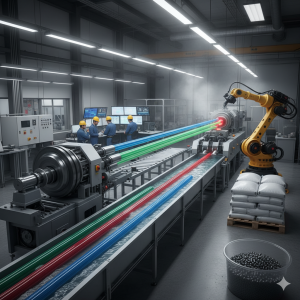
Strand palletizing is a pelletizing method in which molten polymer is extruded through a die head into long, continuous strands. These strands are then cooled, solidified, and cut into pellets by a rotating cutter. The resulting pellets typically have:
- Excellent dimensional consistency
- Good flowability
- Uniform composition
- Controlled moisture content
These characteristics make strand-pelletized materials ideal for applications requiring structural reliability, such as plastic pallets.
How Strand Palletizing Works
1. Polymer Extrusion
In the extrusion stage, molten polymer—whether virgin resin, recycled plastic, or a compounded blend—is pushed through an extrusion die to form multiple continuous strands. The geometry of the die determines the number of strands produced as well as the initial strand diameter, which directly influences the final pellet size and uniformity.
2. Water Bath Cooling
Immediately after extrusion, the hot polymer strands pass through a water bath for rapid cooling. This cooling process is critical for stabilizing polymer crystallization, maintaining dimensional accuracy, and ensuring a smooth surface finish. Proper temperature control during cooling prevents strand warpage or breakage before the cutting stage.
3. Air Knife Drying
Once cooled, the strands are dried using an air knife or drying blower to remove surface moisture. Effective drying is essential to prevent water contamination inside the pelletizer and to reduce the risk of oxidation or defects during subsequent processing.
4. Strand Cutting
The dried strands are then fed into a strand pelletizer, where rotating knives cut them into uniform cylindrical pellets. Pellet length is controlled by the cutting speed and typically ranges from 2 mm to 5 mm, depending on machine settings and application requirements.
5. Classification and Screening
After cutting, the pellets undergo classification and screening to remove fines, oversized pellets, and broken fragments. Maintaining consistent pellet size and shape is crucial for stable feeding, uniform melting, and improved performance in downstream processes such as injection molding or extrusion.
Importance of Strand Pelletizing for Plastic Pallet Production
1. Enhancing Mechanical Strength
Plastic pallets are required to withstand heavy static loads, impact forces, and repeated handling in warehouse environments. Strand pelletizing plays an important role in achieving this performance by producing polymer pellets that melt uniformly, maintain consistent density, and contain evenly dispersed additives. As a result, the molded pallets exhibit higher tensile strength, improved load-bearing capacity, and a significantly reduced risk of cracking or structural failure during use.
2. Improved Melt Flow Behavior
Injection molding and compression molding processes used in plastic pallet manufacturing demand smooth and stable melt flow, especially when filling large and complex mold cavities. Uniform strand pellets provide a predictable melt flow index and controlled viscosity, enabling faster cycle times and more stable processing conditions. This directly improves production efficiency while ensuring consistent pallet quality.
3. Better Additive Distribution
Plastic pallets commonly incorporate functional additives such as impact modifiers, UV stabilizers, anti-static agents, colorants, and reinforcing fillers. Strand pelletizing ensures thorough and uniform mixing of these additives along the entire polymer strand, which prevents defects such as weak zones, uneven coloration, brittleness, or localized performance degradation in the finished pallet.
4. Ideal for Recycled Materials
Recycled HDPE and PP are widely used in pallet production to reduce cost and improve sustainability. Strand pelletizing supports the effective use of recycled materials by allowing melt filtration to remove impurities, producing cleaner and more uniform pellets, and improving compatibility between recycled and virgin resins. This results in stronger recycled pallets and minimizes quality variations commonly associated with inconsistent recyclate.
5. Reduced Defects in Pallet Molding
The consistency of strand-pelletized materials significantly reduces molding defects during pallet production. Manufacturers experience fewer issues such as short shots, warpage, sink marks, uneven cooling, and surface imperfections. With uniform pellets, process parameters remain more stable, reducing the need for frequent adjustments and enabling reliable, long-term production runs.
Conclusion
Strand palletizing is a foundational technology in the polymer industry, providing high-quality pellets essential for producing strong, durable, and dimensionally stable plastic pallets. From enhancing melt flow to ensuring superior additive dispersion, the method directly supports the performance and reliability of pallets used across global supply chains. As demand for high-performance pallets grows—especially in automation, cold storage, and heavy-duty logistics—strand pelletizing remains a critical process that enables manufacturers to maintain consistent quality and operational efficiency
#palletplastik #plasticpallet #paletplastik #palletplastiksewa #palletplastikorisinil #palletplastikrecycle #palletsewa #sewapallet #sewapalletplastik #palletplastikindonesia #palletplastikinjeksi #palletplastikinjection #palletplastikhigienis #palletplastikdoubledeck #gudangsewa #palletplastikgudang #gudangcoldstorage #palletreversible