

Automatic Pallet Stacker In Modern Warehouse Systems
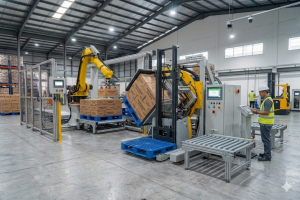
An automatic pallet stacker is an industrial machine designed to organize and stack empty pallets in a neat and efficient manner without requiring significant manual labor. In warehouses, manufacturing plants, and logistics centers, pallets are constantly used to transport and store goods. After pallets are unloaded, they often need to be collected and stacked properly for reuse. Automatic pallet stackers simplify this process by arranging pallets into stable stacks automatically. As companies increasingly adopt automation to improve efficiency, pallet stackers have become important equipment in modern material handling systems. These machines help maintain warehouse organization, reduce manual handling tasks, and optimize space utilization.
Working Principle of An Automatic Pallet Stacker
The operation of an automatic pallet stacker begins when empty pallets are transported to the machine through a conveyor system or manually placed at the machine’s input area. Sensors detect the presence of a pallet and confirm its correct position before the stacking process begins. Once the pallet is detected, the machine’s lifting or clamping mechanism grips the pallet and raises it slightly. The pallet is then aligned and placed on top of the existing pallet stack. The system continues repeating this process until the stack reaches a predetermined height. After the stack is completed, it can be removed by a forklift or transferred automatically to another conveyor system for storage or redistribution. This automated process ensures that pallets are stacked consistently and safely.
Key Components of The Machine
An automatic pallet stacker consists of several essential components that work together to perform the stacking operation. One of the main components is the lifting mechanism, which may use hydraulic or electric actuators to raise and lower pallets during stacking. Another important component is the frame structure that holds the pallet stack in position. This structure ensures that the pallets remain stable as new pallets are added to the stack.
Sensors and control systems are also critical elements. Sensors detect pallet presence and alignment, while the control unit manages the stacking sequence and ensures smooth operation. In many installations, automatic pallet stackers are integrated with conveyor systems that transport pallets to and from the machine. This integration allows continuous pallet flow within automated production lines or warehouse systems.
Advantages In Warehouse Operations
One of the primary benefits of an automatic pallet stacker is improved operational efficiency. The machine can stack pallets quickly and consistently, allowing workers to focus on other tasks within the warehouse. Another advantage is reduced labor requirements. Manual pallet stacking can be physically demanding and time-consuming. Automated stackers eliminate much of this manual effort, reducing fatigue and the risk of workplace injuries.
Automatic pallet stackers also improve warehouse organization. Properly stacked pallets take up less space and are easier to transport or store. This contributes to more efficient warehouse layouts and better use of available floor space. Additionally, automated stacking ensures uniform pallet stacks, which improves safety when stacks are moved by forklifts or other material handling equipment.
Relationship With Plastic Pallets
Automatic pallet stackers are particularly effective when used with plastic pallets. Plastic pallets have consistent dimensions and structural stability, making them easier for automated systems to handle. Because plastic pallets do not warp, crack, or splinter like wooden pallets, they maintain their shape over time. This consistency allows automatic stackers to grip and align pallets more accurately during stacking operations. Plastic pallets are also lighter and cleaner than many wooden pallets, which further improves compatibility with automated handling equipment. As a result, many automated warehouses prefer plastic pallets when implementing pallet stacker systems.
Applications Across Industries
Automatic pallet stackers are widely used in industries that handle large volumes of palletized goods. Manufacturing plants use these machines to manage empty pallets returned from production lines. In logistics and distribution centers, pallet stackers help organize pallets before they are reused for shipping operations. The food and beverage industry also benefits from automated pallet stacking because it supports efficient and hygienic handling practices. Retail distribution centers and packaging facilities often integrate pallet stackers into automated production lines to maintain smooth material flow.
Conclusion
Automatic pallet stackers play an important role in improving efficiency and organization within modern warehouses and industrial facilities. By automating the process of collecting and stacking empty pallets, these machines reduce manual labor, improve safety, and optimize storage space. When combined with durable and dimensionally consistent plastic pallets, automatic pallet stackers become even more effective in supporting automated material handling and logistics operations.
#palletplastik #plasticpallet #paletplastik #palletplastiksewa #palletplastikorisinil #palletplastikrecycle #palletsewa #sewapallet #sewapalletplastik #palletplastikindonesia #palletplastikinjeksi #palletplastikinjection #palletplastikhigienis #palletplastikdoubledeck #gudangsewa #palletplastikgudang #gudangcoldstorage #palletreversible #palletplastikkuat #palletracking #rackingsystem #rentalpalletplastik