

Automatic Pallet Dispenser In Modern Material Handling
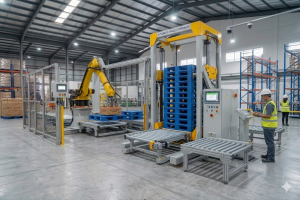
An automatic pallet dispenser is an industrial machine designed to automatically separate and supply individual pallets from a stacked group. In warehouses, manufacturing facilities, and packaging lines, pallets are constantly required to support products during storage and transportation. Instead of manually separating pallets from a stack, an automatic pallet dispenser performs this task efficiently and consistently. With the growing adoption of automation in logistics and manufacturing, pallet dispensers have become an essential component in automated material handling systems. These machines help ensure that pallets are delivered to the correct location at the right time, improving workflow efficiency and reducing manual labor.
Working Principle of An Automatic Pallet Dispenser
The operation of an automatic pallet dispenser begins with a stack of pallets being loaded into the machine. This stack may be placed manually by an operator or delivered by a forklift or conveyor system. Once the pallet stack is inside the machine, a mechanical separation mechanism holds the upper pallets in place while releasing the bottom pallet. The bottom pallet is then lowered and transferred to a conveyor system or directly to the production line where it will be used for palletizing goods. After the first pallet is dispensed, the remaining stack moves downward, positioning the next pallet for release. This process repeats automatically until the entire stack has been distributed. Sensors and control systems ensure that pallets are dispensed one at a time and aligned properly for further handling.
Key Components of The Machine
An automatic pallet dispenser typically consists of several essential components that enable its operation. One of the most important parts is the separation mechanism. This system uses clamps, hooks, or mechanical arms to hold the upper pallets while releasing the bottom pallet. Another key component is the frame structure that supports the pallet stack. This frame must be strong enough to hold multiple pallets and maintain stability during the dispensing process. Sensors are also integrated into the machine to detect pallet presence and ensure proper positioning. These sensors communicate with the control system, which manages the timing and sequence of pallet release. Additionally, many pallet dispensers are integrated with conveyor systems that transport the dispensed pallets to the next stage of the operation, such as palletizing stations or packaging lines.
Advantages In Warehouse And Production Operations
One of the main advantages of automatic pallet dispensers is improved operational efficiency. By automating the pallet supply process, companies can maintain a continuous production flow without interruptions caused by manual pallet handling. Another important benefit is reduced labor requirements. Manually separating pallets from a stack can be time-consuming and physically demanding. Automated dispensers eliminate much of this manual effort and allow workers to focus on more complex tasks. Automatic pallet dispensers also improve workplace safety. Stacks of pallets can be heavy and unstable when handled manually, which increases the risk of accidents. By using automated equipment, the handling process becomes more controlled and predictable. Furthermore, the machine ensures consistent pallet orientation and positioning. This consistency is particularly important in automated systems where pallets must align precisely with conveyors, robotic palletizers, or packaging equipment.
Relationship With Plastic Pallets
Automatic pallet dispensers often perform very efficiently when handling plastic pallets. Plastic pallets have consistent dimensions and uniform structural characteristics, which makes them easier for automated equipment to handle. Unlike wooden pallets that may warp, crack, or vary in size, plastic pallets maintain stable shapes over long periods of use. This dimensional stability helps the dispenser mechanism separate pallets more accurately and reduces the risk of jams during the dispensing process. Plastic pallets are also cleaner and smoother than wooden pallets, which helps prevent mechanical interference within automated systems. For this reason, many automated warehouses prefer plastic pallets when integrating pallet dispensers into their material handling processes.
Applications Across Industries
Automatic pallet dispensers are widely used in industries that require continuous pallet supply for production or packaging lines. Manufacturing facilities use them to feed pallets into robotic palletizing systems. In logistics and distribution centers, pallet dispensers help prepare pallets for order fulfillment and shipping operations. The food and beverage industry also benefits from automated pallet dispensing because it supports hygienic handling environments. Packaging plants and consumer goods manufacturers frequently integrate pallet dispensers into automated production lines to maintain smooth and uninterrupted operations.
Conclusion
Automatic pallet dispensers are an important component of modern automated material handling systems. By efficiently separating and delivering pallets from a stack, these machines improve productivity, reduce manual labor, and enhance workplace safety. When combined with durable and dimensionally consistent plastic pallets, automatic pallet dispensers provide reliable support for efficient warehouse and production operations.
#palletplastik #plasticpallet #paletplastik #palletplastiksewa #palletplastikorisinil #palletplastikrecycle #palletsewa #sewapallet #sewapalletplastik #palletplastikindonesia #palletplastikinjeksi #palletplastikinjection #palletplastikhigienis #palletplastikdoubledeck #gudangsewa #palletplastikgudang #gudangcoldstorage #palletreversible #palletplastikkuat #palletracking #rackingsystem #rentalpalletplastik