
Ejector Plate in Plastic Pallet (Pallet Plastik) Molds: A Key Component for Efficient Part Ejection
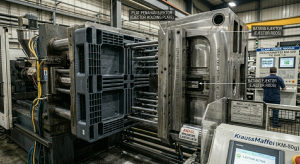
Its primary function is to transfer force from the injection molding machine to the ejector pins, sleeves, or other ejection components that push the molded product out of the mold cavity. In plastic pallet molds, the ejector plate is particularly important because pallets are large products with extensive surface contact areas. After cooling, the pallet may adhere firmly to the mold surface due to material shrinkage and vacuum effects. The ejector plate ensures that sufficient and evenly distributed force is applied to release the pallet without causing damage.
How The Ejector Plate Works
The ejector plate operates as part of the mold’s ejection mechanism. After the molten plastic has cooled and solidified, the mold opens and the pallet remains attached to the moving half of the mold. At this stage, the injection molding machine activates the ejector system. The ejector rod pushes the ejector plate forward, causing all connected ejector pins and other ejection components to move simultaneously. These components apply pressure to strategic areas of the pallet, separating it from the mold surface. Once the pallet has been fully ejected, the ejector plate returns to its original position, allowing the mold to close and begin the next production cycle.
Importance In Plastic Pallet Manufacturing
Plastic pallets are significantly larger and heavier than many conventional injection-molded products. Their complex structure often includes numerous ribs, support legs, and reinforcement features that increase mold contact area. Without a properly functioning ejector plate, several production issues can occur, including:
- Product sticking inside the mold
- Uneven ejection force
- Surface damage
- Warpage and deformation
- Extended cycle times
- Increased mold wear
The ejector plate helps distribute ejection forces evenly across multiple ejector pins. This balanced force distribution is essential for preventing localized stress that could damage the pallet or reduce its structural integrity. For manufacturers producing heavy-duty pallets, reliable ejection is a critical factor in maintaining consistent quality and high production output.
Design Considerations
The design of an ejector plate for a pallet mold requires careful engineering. Because pallet molds are large and often contain dozens or even hundreds of ejector pins, the ejector plate must be strong enough to handle significant mechanical loads. Engineers typically consider several factors during design, including:
- Pallet dimensions
- Product weight
- Number of ejector pins
- Ejection force requirements
- Mold cycle frequency
- Material shrinkage characteristics
The ejector plate must also maintain precise alignment throughout its movement. Any misalignment can lead to uneven pin movement, excessive wear, or product defects.
Materials And Construction
Ejector plates are commonly manufactured from high-strength steel capable of withstanding repeated mechanical stress over millions of production cycles. Precision machining is essential to ensure smooth operation and accurate positioning within the mold assembly. In large pallet molds, ejector plates are often thicker and more robust than those used in molds for smaller consumer products. This increased strength helps prevent bending or deformation during operation. Surface treatments and proper lubrication are also important for reducing wear and maintaining long-term performance.
Maintenance And Inspection
Routine maintenance is essential to ensure reliable ejector plate operation. Mold technicians should inspect the ejector plate regularly for signs of wear, cracking, corrosion, or misalignment. Lubrication of guide components and moving surfaces helps reduce friction and prevents premature wear. Cleaning should also be performed periodically to remove plastic residue, dust, and contaminants that may interfere with smooth movement. Preventive maintenance not only extends the lifespan of the ejector plate but also reduces the risk of unexpected downtime and costly repairs.
Conclusion
The ejector plate is a vital component of the ejection system in plastic pallet molds. By transferring force to ejector pins and ensuring uniform pallet release, it plays a major role in maintaining product quality, production efficiency, and mold reliability. Its ability to distribute ejection forces evenly helps prevent product damage and supports the manufacturing of high-quality plastic pallets. With proper design, material selection, and maintenance, the ejector plate contributes significantly to the long-term success of plastic pallet production operations.
#palletplastik #plasticpallet #paletplastik #palletplastiksewa #palletplastikorisinil #palletplastikrecycle #palletsewa #sewapallet #sewapalletplastik #palletplastikindonesia #palletplastikinjeksi #palletplastikinjection #palletplastikhigienis #palletplastikdoubledeck #gudangsewa #palletplastikgudang #gudangcoldstorage #palletreversible #palletplastikkuat #palletracking #rackingsystem #rentalpalletplastik